


Have you ever wondered how people in the past envisioned today? It’s both amusing and bewildering to think about the wild predictions they made. From flying cars to household robots that could cook gourmet meals, expectations were lofty. As futuristic as these ideas sounded, some were downright hilarious. This article explores those old predictions of the future, revealing what was on target, and what completely missed the mark. Buckle up as we journey through time and peek into the crystal balls of yesteryear.
Fascinating Historical Predictions
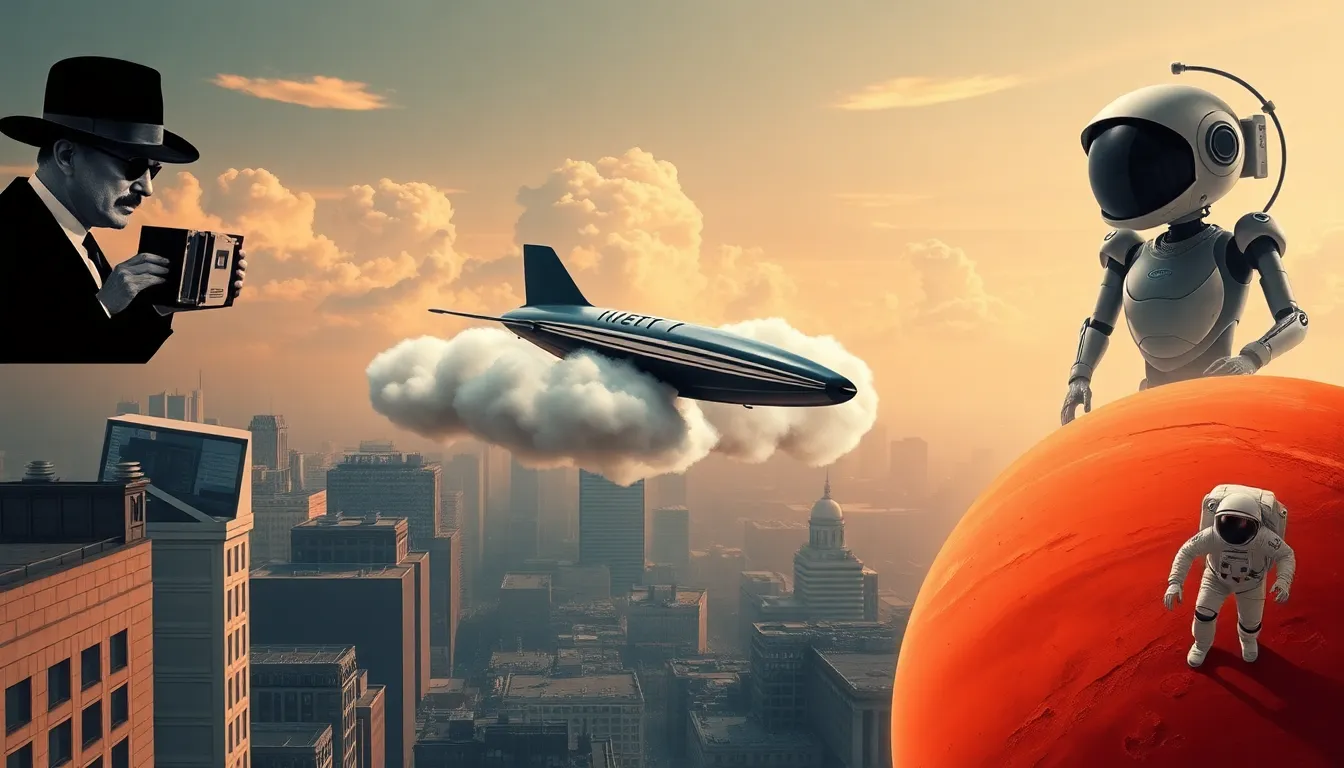
Throughout history, humans have attempted to predict the future. Take, for instance, the 19th-century prediction that by the year 2000, people would have their own personal flying machines. Can you picture it? Commuting to work while avoiding traffic jams above the clouds sounds delightful, but alas, we still haven’t mastered that feat. History is peppered with predictions that sparked excitement, fueling imaginations and ambitions.
George Orwell’s dystopian vision in “1984” painted a future where Big Brother watched every move. Surprisingly, some aspects of this prediction resonate with today’s reality, look no further than the prevalence of surveillance technology. In the 1950s, we were told that by the turn of the millennium, everyone would have a personal robot servant. If only we were as lucky as the Jetsons.
What about the predictions made about space travel? As early as the 1960s, many believed we would have colonized Mars by 2020. While we’re making strides, we’re still light-years away from establishing a Martian suburb. These fascinating historical predictions reveal both the hopes and follies of human foresight.
The Role of Science Fiction in Shaping Expectations
Science fiction has played a pivotal role in shaping societal expectations about the future. Through the lens of creativity, it has sparked imaginations and inspired inventors. Iconic works like Jules Verne’s “From the Earth to the Moon” in 1865 not only entertained readers but also inspired real-world space exploration. Besides, Arthur C. Clarke’s “2001: A Space Odyssey” managed to predict technologies like artificial intelligence and video conferencing, concepts that are now ingrained in everyday life.
Authors have painted visions of utopian and dystopian futures, influencing public perception of what’s possible. Keep in mind that these stories often highlight moral dilemmas and social constructs, giving people a framework to navigate the future’s uncertainties. They may not always accurately predict specific technologies, but they certainly shape the cultural context within which such innovations arise.
Technological Predictions That Came True
Let’s give credit where credit is due. Some predictions of the future turned out to be remarkably accurate. In 1965, Gordon Moore famously noted that technology would double its capacity every two years, a prediction that holds true today. The rapid advancement in computing power has led to innovations that are woven into our daily lives.
Imagine the surprise of those who first saw mobile phones. Once the stuff of science fiction, they are now an indelible part of human communication. Even more astounding is the internet, which has revolutionized how we connect, learn, and consume information. Without the predictions that sparked these innovations, we might still be fumbling through rotary phones and encyclopedias.
Besides, medical advancements such as robotic surgery and telemedicine have transformed healthcare. Doctors can now operate on patients thousands of miles away, offering solutions once relegated to the realm of fantasy. This illustrates the power of predictions becoming reality when paired with relentless human ingenuity.
Predictions That Missed the Mark
On the flip side, not every bold prediction hit the nail on the head. One notorious example is the prediction that by the year 2000, we would be driving around in fully automated flying cars. While innovations like drones advance the concept, we’re more likely to end up with self-driving cars on well-paved roads than soaring through the skies.
Another laughable miss was the 1970s prediction of nuclear-powered households. The idea that homes would be running on mini nuclear power plants seems far-fetched for most today. Not only are there safety concerns, but convincing homeowners to manage a nuclear reactor in their basement seems precarious at best.
Then there’s the prediction of a paperless future. Remember the early optimism about digital documents replacing paper? While we’ve certainly made headway with electronic communication, paper products are still very much in demand. From sticky notes to printed photos, the world remains attached to our paper habits.
Cultural and Societal Predictions
Predictions about societal and cultural shifts also occupy a fascinating niche. Some futurists believed that by now, everyone would be living in a global village where language barriers would dissolve thanks to technology. Meanwhile, the internet has given rise to new forms of communication, yet cultural divides still persist. In reality, the world is more interconnected but also more fragmented than ever.
Consider the predictions surrounding gender roles. Many thought that by the 21st century, gender equality would be fully realized, but we still have significant strides to make. Even though advancements in women’s rights, societal norms and traditions often lag behind technological innovations.
Besides, the expectation that technology would lead to a world of leisure has yet to pan out. Instead of freeing up our time, many find themselves working harder than ever, thanks to instant communication and the pressure to always be ‘on’. These societal and cultural predictions reveal the complexity of human progress.
Lessons Learned from Past Predictions
What can be gleaned from the tapestry of predictions woven throughout history? First, it’s crucial to realize that human creativity knows no bounds. The gap between imagination and reality often narrows as technology advances. But, the ability to forecast accurately depends heavily on understanding societal values and needs.
Also, hindsight is 20/20. While some predictions may seem foolish now, they often laid the groundwork for innovation. They encourage critical thinking and challenge the status quo. The mistakes made and the successes achieved offer invaluable lessons for futurists and innovators today. Embracing uncertainty while remaining open to possibilities can lead to breakthroughs.